

2.2.3 Practice African American Migration
| Role of the Nadir of American race relations | |
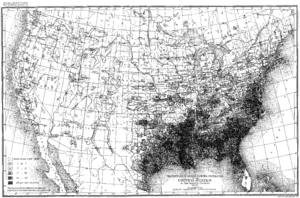 Usa map of the Black American population from 1900 U.S. Census | |
| Date | 1910s–1970 |
|---|---|
| Location | United States |
| Also known as | Neat Northward Migration Black Migration |
| Crusade | Poor economic atmospheric condition Racial segregation in the The states:
|
| Participants | about 6,000,000 African Americans |
| Outcome | Demographic shifts across the U.Southward. Improved living conditions for African-Americans |
The Nifty Migration, sometimes known equally the Groovy Due north Migration or the Black Migration, was the movement of six one thousand thousand African Americans out of the rural Southern U.s.a. to the urban Northeast, Midwest, and West between 1910 and 1970.[i] Information technology was caused primarily by the poor economical conditions for African American people, besides as the prevalent racial segregation and bigotry in the Southern states where Jim Crow laws were upheld.[2] [3] In item, continued lynchings motivated a portion of the migrants, every bit African Americans searched for social reprieve. The historic alter brought past the migration was amplified because the migrants, for the most part, moved to the then-largest cities in the United States (New York Metropolis, Chicago, Detroit, Los Angeles, Philadelphia, Cleveland, and Washington, D.C.) at a time when those cities had a primal cultural, social, political, and economical influence over the The states.[4] There, African Americans established influential communities of their own.[4] Despite the loss of leaving their homes in the Southward, and all the barriers faced by the migrants in their new homes, the migration was an act of private and collective agency, which changed the form of American history, a "declaration of independence" written by their actions.[5]
From the earliest U.S. population statistics in 1780 until 1910, more than 90% of the African-American population lived in the American S,[6] [seven] [8] making up the majority of the population in iii Southern states, viz. Louisiana (until about 1890[nine]), South Carolina (until the 1920s[10]), and Mississippi (until the 1930s[xi]). Only by the cease of the Great Migration, merely over half of the African-American population lived in the South, while a little less than half lived in the North and W.[12] Moreover, the African-American population had go highly urbanized. In 1900, only one-fifth of African Americans in the Southward were living in urban areas.[13] Past 1960, one-half of the African Americans in the South lived in urban areas,[13] and by 1970, more than 80% of African Americans nationwide lived in cities.[14] In 1991, Nicholas Lemann wrote:
The Neat Migration was one of the largest and virtually rapid mass internal movements in history—possibly the greatest not caused by the immediate threat of execution or starvation. In sheer numbers, information technology outranks the migration of any other ethnic group—Italians or Irish or Jews or Poles—to the United States. For Black people, the migration meant leaving what had always been their economical and social base in America and finding a new ane.[15]
Some historians differentiate betwixt a first Keen Migration (1910–forty), which saw about i.6 million people move from mostly rural areas in the South to northern industrial cities, and a Second Dandy Migration (1940–lxx), which began after the Bully Depression and brought at least five million people—including many townspeople with urban skills—to the North and West.[16]
Since the Civil Rights Motility, the trend has reversed, with more African-Americans moving to the South, admitting far more slowly. Dubbed the New Great Migration, these moves were generally spurred by the economic difficulties of cities in the Northeastern and Midwestern United states, growth of jobs in the "New South" and its lower cost of living, family unit and kinship ties, and lessening discrimination at the easily of white people.[17]
Causes [edit]

The Arthur family arrived at Chicago's Polk Street Depot on Baronial 30, 1920, during the Great Migration.[18]
The principal factors for migration among southern African Americans were segregation, indentured servitude, convict leasing, an increase in the spread of racist ideology, widespread lynching (nigh 3,500 African Americans were lynched between 1882 and 1968[19]), and lack of social and economic opportunities in the South. Some factors pulled migrants to the north, such equally labor shortages in northern factories brought about by World War I, resulting in thousands of jobs in steel mills, railroads, meatpacking plants, and the automobile manufacture.[20] The pull of jobs in the north was strengthened by the efforts of labor agents sent past northern businessmen to recruit southern workers.[xx] Northern companies offered special incentives to encourage Black workers to relocate, including gratuitous transportation and low-toll housing.[21]
During Globe War I, there was a refuse in European immigrants, which acquired Northern factories to feel the impact of a low supply of workers. Around 1.2 million European immigrants arrived during 1914 while merely 300,000 arrived the adjacent twelvemonth. The enlistment of workers into the military had besides affected the labor supply. This created a wartime opportunity in the North for African Americans, as the Northern industry sought a new labor supply in the South.[22]
There were many advantages for Northern jobs compared to Southern jobs including wages that could be double or more. Sharecropping, agricultural depression, the widespread infestation of the boll weevil, and flooding too provided motives for African Americans to movement into the Northern Cities. The lack of political power, representation, and social opportunities due to a culture regulated by Jim Crow laws likewise motivated African Americans to migrate Northward.[22]
First Dandy Migration (1910–1940) [edit]
When the Emancipation Proclamation was signed in 1863, less than viii percentage of the African-American population lived in the Northeastern or Midwestern United States.[23] This began to change over the next decade; by 1880, migration was underway to Kansas. The U.S. Senate ordered an investigation into information technology.[24] In 1900, about 90 percent of Black Americans yet lived in Southern states.[23]
Betwixt 1910 and 1930, the African-American population increased by about forty percent in Northern states every bit a outcome of the migration, generally in the major cities. The cities of Philadelphia, Detroit, Chicago, Cleveland, Baltimore, and New York City had some of the biggest increases in the early part of the twentieth century. Tens of thousands of Black workers were recruited for industrial jobs, such equally positions related to the expansion of the Pennsylvania Railroad. Considering changes were full-bodied in cities, which had also attracted millions of new or recent European immigrants, tensions rose as the people competed for jobs and deficient housing. Tensions were oft most severe betwixt ethnic Irish, defending their recently gained positions and territory, and recent immigrants and Black people.[ commendation needed ]
Tensions and violence [edit]
With the migration of African Americans Northward and the mixing of White and Black workers in factories, the tension was building, largely driven by White workers. The AFL, the American Federation of Labor, advocated the separation between European Americans and African Americans in the workplace. There were non-violent protests such as walk-outs in protest of having Blacks and Whites working together. Equally tension was building due to advocating for segregation in the workplace, violence soon erupted.[25]
In 1917, the E St Louis Illinois Riot, known for i of the bloodiest workplace riots, had between 40 and 200 killed and over 6000 African Americans displaced from their homes. The NAACP, National Association for the Advocacy of Colored People, responded to the violence with a march known as the Silent March. Over 10,000 African American men and women demonstrated in Harlem, New York. Conflicts continued post World War I, as African Americans connected to face conflicts and tension while the African American labor activism continued.[25]
In the late summer and autumn of 1919, racial tensions became vehement and came to be known as the Red Summer. This period of fourth dimension was defined by violence and prolonged rioting between Blackness and white Americans in major United states cities.[26] The reasons for this violence vary. Cities that were affected by the violence included Washington D.C., Chicago, Omaha, Knoxville, Tennessee, and Elaine, Arkansas, a small-scale rural town seventy miles (110 km) southwest of Memphis.[27]
The race riots peaked in Chicago, with the most violence and death occurring there during the riots.[28] The authors of The Negro in Chicago; a study of race relations and a race riot, an official written report from 1922 on race relations in Chicago, came to the conclusion that there were many factors that led to the violent outbursts in Chicago. Principally, many Black workers had assumed the jobs of white men who went to go fight in World State of war I. As the war ended in 1918, many men returned home to discover out their jobs had been taken past Black men who were willing to piece of work for far less.[27]
By the fourth dimension the rioting and violence had subsided in Chicago, 38 people had lost their lives, with 500 more injured. Additionally, $250,000 worth of property was destroyed, and over a thousand persons were left homeless.[29] In other cities across the nation many more than had been affected by the violence of the Cherry Summer. The Cerise Summer enlightened many to the growing racial tension in America. The violence in these major cities prefaced the soon to follow Harlem Renaissance, an African-American cultural revolution, in the 1920s.[28] Racial violence appeared once more in Chicago in the 1940s and in Detroit as well as other cities in the Northeast as racial tensions over housing and employment discrimination grew.
Continued migration [edit]
James Gregory calculates decade-by-decade migration volumes in his book The Southern Diaspora. Blackness migration picked up from the start of the new century, with 204,000 leaving in the first decade. The pace accelerated with the outbreak of Globe War I and connected through the 1920s. By 1930, at that place were ane.three million former southerners living in other regions.[30] : 22
The Great Low wiped out chore opportunities in the northern industrial chugalug, specially for African Americans, and caused a precipitous reduction in migration. In the 1930s and 1940s, increasing mechanization of agriculture virtually brought the institution of sharecropping that had existed since the Ceremonious War to an cease in the The states causing many landless Black farmers to exist forced off of the country.[31]
As a effect, approximately one.4 1000000 Black southerners moved north or west in the 1940s, followed by one.i million in the 1950s, and some other 2.4 million people in the 1960s and early on 1970s. By the belatedly 1970s, as deindustrialization and the Rust Belt crisis took concord, the Swell Migration came to an stop. But, in a reflection of changing economics, equally well every bit the end of Jim Crow laws in the 1960s and improving race relations in the South, in the 1980s and early on 1990s, more Black Americans were heading South than leaving that region.[32] : 12–17
African Americans moved from the 14 states of the Southward, especially Alabama, Mississippi, Louisiana, Texas, and Georgia.[32] : 12
2d Great Migration (mid 1940s–1970) [edit]
The Keen Depression of the 1930s resulted in reduced migration because of decreased opportunities. With the defense buildup for Earth State of war 2 and with the post-war economical prosperity, migration was revived, with larger numbers of Black Americans leaving the South through the 1960s. This wave of migration oftentimes resulted in overcrowding of urban areas due to exclusionary housing policies meant to keep African American families out of developing suburbs.[ citation needed ]
Migration patterns [edit]
Large cities were the principal destinations of southerners throughout the two phases of the Dandy Migration. In the beginning phase, eight major cities attracted ii-thirds of the migrants: New York and Chicago, followed in order by Philadelphia, St. Louis, Denver, Detroit, Kansas City, Pittsburgh, and Indianapolis. The Second great Blackness migration increased the populations of these cities while adding others as destinations, including the Western states. Western cities such equally Los Angeles, San Francisco, Oakland, Phoenix, Seattle, and Portland likewise managed to concenter African Americans in big numbers.[thirty] : 22
There were clear migratory patterns that linked particular states and cities in the South to corresponding destinations in the North and West. Almost half of those who migrated from Mississippi during the start Smashing Migration, for example, ended upward in Chicago, while those from Virginia tended to move to Philadelphia. For the well-nigh part, these patterns were related to geography (i.e. longitude), with the closest cities alluring the most migrants (such as Los Angeles and San Francisco receiving a disproportionate number of migrants from Texas and Louisiana). When multiple destinations were equidistant, concatenation migration played a larger office, with migrants following the path prepare by those before them.[21]
African Americans from the South as well migrated to industrialized Southern cities, in improver to northward and westward to state of war-boom cities. At that place was an increment in Louisville'southward defence force industries, making it a vital function of America'southward endeavor into Earth War 2 and Louisville's economy. Industries ranged from producing synthetic prophylactic, smokeless powders, arms shells, and vehicle parts. Many industries as well converted to creating products for the war effort, such as Ford Motor Company converting its found to produce military jeeps. The company Hillerich & Bradsby initially made baseball bats and then converted their production into making gunstocks.[33] [34]
During the war, there was a shortage of workers in the defence manufacture. African Americans took the opportunity to make full in the industries' missing jobs during the war, around 4.3 meg intrastate migration and two.i one thousand thousand interstate migration in the Southern states. The defence force industry in Louisville reached a meridian of roughly over 80,000 employment. At first, chore availability was non open up for African Americans, just the growing need for jobs in the defense industry and the Fair Employment Practices Committee sign by Franklin D. Roosevelt, the Southern industries began to take African Americans into the workplace.[35] [34]
Migration patterns reflected network ties. Blackness Americans tended to become to locations in the N where other Black Americans had previously migrated. Per a 2021 study, "when one randomly chosen African American moved from a Southern birth town to a destination county, then 1.9 additional Blackness migrants fabricated the same move on boilerplate."[36]
Gallery [edit]
-

Graph showing the percentage of the African-American population living in the American Southward, 1790–2010
-

The Dandy Migration shown past changes in the African-American share of populations of major U.S. cities, 1910–40 and 1940–seventy
-
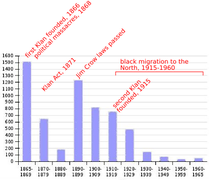
Racially motivated murders per decade from 1865 to 1965.
Cultural changes [edit]
After moving from the racist environment of the south to the northern states, African Americans were inspired to exist creative in different ways. The Great Migration resulted in the Harlem Renaissance, which was also fueled past immigrants from the Caribbean, and the Chicago Blackness Renaissance. In her book The Warmth of Other Suns, Pulitzer Prize–winning journalist Isabel Wilkerson discusses the migration of "six million Black Southerners [moving] out of the terror of Jim Crow to an uncertain existence in the North and Midwest."[37]
The struggle of African-American migrants to adapt to Northern cities was the subject of Jacob Lawrence's Migration Serial of paintings, created when he was a swain in New York.[38] Exhibited in 1941 at the Museum of Modern Art, Lawrence'southward Serial attracted wide attending; he was quickly perceived every bit i of the nigh important African-American artists of the time.[39]
The Great Migration had effects on music likewise every bit other cultural subjects. Many blues singers migrated from the Mississippi Delta to Chicago to escape racial discrimination. Muddy Waters, Chester Burnett, and Buddy Guy are among the most well-known blues artists who migrated to Chicago. Great Delta-built-in pianist Eddie Boyd told Living Dejection magazine, "I idea of coming to Chicago where I could get away from some of that racism and where I would accept an opportunity to, well, do something with my talent.... It wasn't peaches and cream [in Chicago], man, but information technology was a hell of a lot better than downward at that place where I was born."[40]
Furnishings [edit]
Demographic changes [edit]
The Bully Migration tuckered off much of the rural Blackness population of the South, and for a time, froze or reduced African-American population growth in parts of the region. The migration changed the demographics in a number of states; there were decades of Blackness population decline, specially beyond the Deep South "black belt" where cotton had been the main cash ingather[32] : eighteen — but had been devastated by the arrival of the boll weevil.[41] In 1910, African Americans constituted the majority of the population of South Carolina and Mississippi, and more than 40 percent in Georgia, Alabama, Louisiana and Texas; by 1970, but in Mississippi did the African-American population constitute more than xxx pct of the land's full. "The disappearance of the 'blackness chugalug' was ane of the striking furnishings" of the Great Migration, James Gregory wrote.[32] : 18
In Mississippi, the Black American population decreased from about 56% of the population in 1910 to about 37% by 1970,[42] remaining the majority only in some Delta counties. In Georgia, Black Americans decreased from most 45% of the population in 1910 to about 26% past 1970. In South Carolina, the Black population decreased from about 55% of the population in 1910 to about 30% by 1970.[42]
The growing Black presence exterior the Due south inverse the dynamics and demographics of numerous cities in the Northeast, Midwest, and West. In 1900, only 740,000 African Americans lived exterior the S, just 8 percent of the nation's total Black population. Past 1970, more than 10.half-dozen million African Americans lived outside the South, 47 percent of the nation'due south full.[32] : 18
Because the migrants full-bodied in the big cities of the north and west, their influence was magnified in those places. Cities that had been virtually all white at the start of the century became centers of Black civilisation and politics past mid-century. Residential segregation and redlining led to concentrations of Black people in certain areas. The northern "Black metropolises" developed an important infrastructure of newspapers, businesses, jazz clubs, churches, and political organizations that provided the staging basis for new forms of racial politics and new forms of Black culture.
Every bit a outcome of the Great Migration, the commencement large urban Black communities developed in northern cities across New York, Boston, Baltimore, Washington D.C., and Philadelphia, which had Black communities fifty-fifty before the Civil War, and attracted migrants afterwards the war. Information technology is conservatively estimated that 400,000 African Americans left the South in 1916 through 1918 to take advantage of a labor shortage in industrial cities during the Offset World War.[43]
In 1910, the African-American population of Detroit was 6,000. The Swell Migration, forth with immigrants from southern and eastern Europe too as their descendants, rapidly turned the city into the country's fourth-largest. By the start of the Great Depression in 1929, the city'south African-American population had increased to 120,000.
In 1900–01, Chicago had a total population of 1,754,473.[44] By 1920, the urban center had added more than than i million residents. During the second wave of the Great Migration (1940–60), the African-American population in the urban center grew from 278,000 to 813,000.

African-American youths play basketball game in Chicago'south Stateway Gardens loftier-rise housing projection in 1973.
The menstruation of African Americans to Ohio, specially to Cleveland, changed the demographics of the state and its primary industrial city. Before the Great Migration, an estimated 1.1% to ane.6% of Cleveland's population was African American.[45] By 1920, 4.3% of Cleveland's population was African American.[45] The number of African Americans in Cleveland connected to ascent over the next 20 years of the Great Migration.
Other northeastern and midwestern industrial cities, such as Philadelphia, New York City, Baltimore, Pittsburgh, St. Louis, and Omaha, also had dramatic increases in their African-American populations. By the 1920s, New York'south Harlem became a heart of Black cultural life, influenced by the American migrants as well as new immigrants from the Caribbean surface area.[46]
Second-tier industrial cities that were destinations for numerous Black migrants were Buffalo, Rochester, Boston, Milwaukee, Minneapolis, Kansas City, Columbus, Cincinnati, One thousand Rapids and Indianapolis, and smaller industrial cities such as Chester, Gary, Dayton, Erie, Toledo, Youngstown, Peoria, Muskegon, Newark, Flint, Saginaw, New Haven, and Albany. People tended to have the cheapest rail ticket possible and get to areas where they had relatives and friends.
For case, many people from Mississippi moved directly north by train to Chicago, Milwaukee and St. Louis, from Alabama to Cleveland and Detroit, from Georgia and South Carolina to New York City, Baltimore, Washington D.C. and Philadelphia, and in the 2d migration, from Texas, Louisiana, and Mississippi to Oakland, Los Angeles, Portland, Phoenix, Denver, and Seattle.[ citation needed ]
Discrimination and working conditions [edit]

Educated African Americans were ameliorate able to obtain jobs after the Great Migration, eventually gaining a measure of class mobility, but the migrants encountered meaning forms of discrimination. Because so many people migrated in a short flow of time, the African-American migrants were oftentimes resented by the urban European-American working class (many of whom were recent immigrants themselves); fearing their ability to negotiate rates of pay or secure employment, the ethnic whites felt threatened by the influx of new labor competition. Sometimes those who were about fearful or resentful were the concluding immigrants of the 19th and new immigrants of the 20th century.[ citation needed ]
African Americans fabricated substantial gains in industrial employment, especially in the steel, automobile, shipbuilding, and meatpacking industries. Between 1910 and 1920, the number of Black workers employed in industry about doubled from 500,000 to 901,000.[43] After the Great Low, more advances took identify after workers in the steel and meatpacking industries organized into labor unions in the 1930s and 1940s, nether the interracial Congress of Industrial Organizations (CIO). The unions ended the segregation of many jobs, and African Americans began to advance into more than skilled jobs and supervisory positions previously informally reserved for whites.
Between 1940 and 1960, the number of Blackness people in managerial and administrative occupations doubled, along with the number of Black people in white-collar occupations, while the number of Black agronomical workers in 1960 vicious to i-fourth of what it was in 1940.[48] Also, between 1936 and 1959, Black income relative to white income more than doubled in diverse skilled trades.[49] Despite employment discrimination,[l] Black people had higher labor force participation rates than whites in every U.S. Demography from 1890 to 1950.[51] Every bit a issue of these advancements, the percentage of Black families living below the poverty line declined from 87 percent in 1940 to 47 percentage by 1960 and to 30 percent past 1970.[52]
Populations increased and so chop-chop amidst both African-American migrants and new European immigrants that at that place were housing shortages in nigh major cities. With fewer resource, the newer groups were forced to compete for the oldest, most run-down housing. Ethnic groups created territories which they defended confronting modify. Bigotry oft restricted African Americans to crowded neighborhoods. The more established populations of cities tended to motion to newer housing every bit it was developing in the outskirts. Mortgage discrimination and redlining in inner city areas limited the newer African-American migrants' power to determine their own housing, or obtain a off-white price. In the long term, the National Housing Act of 1934 contributed to limiting the availability of loans to urban areas, particularly those areas inhabited by African Americans.[53]
Migrants going to Albany, New York found poor living atmospheric condition and employment opportunities, but besides college wages and better schools and social services. Local organizations such equally the Albany Inter-Racial Council and churches, helped them, just de facto segregation and discrimination remained well into the tardily 20th century.[54]
Migrants going to Pittsburgh and surrounding factory towns in western Pennsylvania between 1890 and 1930 faced racial discrimination and limited economical opportunities. The Blackness population in Pittsburgh jumped from half dozen,000 in 1880 to 27,000 in 1910. Many took highly paid, skilled jobs in the steel mills. Pittsburgh'due south Black population increased to 37,700 in 1920 (6.four% of the full) while the Black element in Homestead, Rankin, Braddock, and others nearly doubled. They succeeded in building constructive community responses that enabled the survival of new communities.[55] [56] Historian Joe Trotter explains the conclusion process:
- Although African-Americans oftentimes expressed their views of the Neat Migration in biblical terms and received encouragement from northern Black newspapers, railroad companies, and industrial labor agents, they as well drew upon family and friendship networks to help in the move to Western Pennsylvania. They formed migration clubs, pooled their money, bought tickets at reduced rates, and often moved ingroups. Before they made the conclusion to movement, they gathered information and debated the pros and cons of the procedure....In barbershops, poolrooms, and grocery stores, in churches, lodge halls, and clubhouses, and in private homes, Blackness people who lived in the Due south discussed, debated, and decided what was good and what was bad nearly moving to the urban N.[57]
Integration and segregation [edit]

White tenants seeking to prevent Blackness people from moving into the Sojourner Truth housing project in Detroit erected this sign, 1942
In cities such as Newark, New York and Chicago, African Americans became increasingly integrated into club. As they lived and worked more closely with European Americans, the divide became increasingly indefinite. This period marked the transition for many African Americans from lifestyles every bit rural farmers to urban industrial workers.[58]
This migration gave birth to a cultural blast in cities such as Chicago and New York. In Chicago for instance, the neighborhood of Bronzeville became known every bit the "Black Metropolis". From 1924 to 1929, the "Blackness Metropolis" was at the peak of its gilded years. Many of the community's entrepreneurs were Blackness during this period. "The foundation of the get-go African American YMCA took place in Bronzeville, and worked to assistance incoming migrants discover jobs in the city of Chicago."[59]
The "Black Chugalug" geographical and racial isolation of this community, bordered to the due north and east by whites, and to the south and west by industrial sites and ethnic immigrant neighborhoods, fabricated it a site for the study of the development of an urban Black customs. For urbanized people, eating proper foods in a sanitary, civilized setting such as the home or a eating house was a social ritual that indicated 1'south level of respectability. The people native to Chicago had pride in the loftier level of integration in Chicago restaurants, which they attributed to their unassailable manners and refined tastes.[60]
Since African-American migrants retained many Southern cultural and linguistic traits, such cultural differences created a sense of "otherness" in terms of their reception by others who were already living in the cities.[61] Stereotypes ascribed to Blackness people during this period and ensuing generations often derived from African-American migrants' rural cultural traditions, which were maintained in stark contrast to the urban environments in which the people resided.[61]
White southern reaction [edit]
The beginning of the Great Migration exposed a paradox in race relations in the American South at that time. Although Black people were treated with extreme hostility and subjected to legal discrimination, the southern economy was securely dependent on them as an abundant supply of cheap labor, and Blackness workers were seen every bit the most disquisitional factor in the economic evolution of the South. One South Carolina politico summed up the dilemma: "Politically speaking, in that location are far as well many negroes, but from an industrial standpoint there is room for many more than."[62]
When the Corking Migration started in the 1910s, white southern elites seemed to be unconcerned, and industrialists and cotton wool planters saw information technology as a positive, as it was siphoning off surplus industrial and agricultural labor. As the migration picked up, yet, southern elites began to panic, fearing that a prolonged Black exodus would bankrupt the S, and paper editorials warned of the danger. White employers somewhen took detect and began expressing their fears. White southerners before long began trying to stem the menses in order to prevent the hemorrhaging of their labor supply, and some even began attempting to accost the poor living standards and racial oppression experienced by Southern Blackness people in order to induce them to stay.
As a result, southern employers increased their wages to match those on offering in the North, and some individual employers even opposed the worst excesses of Jim Crow laws. When the measures failed to stalk the tide, white southerners, in concert with federal officials who feared the rise of Black nationalism, co-operated in attempting to coerce Black people to stay in the South. The Southern Metal Trades Clan urged decisive action to stop Black migration, and some employers undertook serious efforts confronting it.[62] [63]
The largest southern steel manufacturer refused to cash checks sent to finance Black migration, efforts were made to restrict coach and train access for Black Americans, agents were stationed in northern cities to report on wage levels, unionization, and the ascent of Black nationalism, and newspapers were pressured to divert more coverage to negative aspects of Black life in the North. A series of local and federal directives were put into identify with the goal of restricting Black mobility, including local vagrancy ordinances, "piece of work or fight" laws demanding all males either be employed or serve in the army, and conscription orders. Intimidation and beatings were also used to terrorize Black people into staying.[62] [63] These intimidation tactics were described by Secretary of Labor William B. Wilson as interfering with "the natural right of workers to motility from place to place at their own discretion".[64]
During the wave of migration that took place in the 1940s, white southerners were less concerned, equally mechanization of agriculture in the belatedly 1930s had resulted in another labor surplus so southern planters put upward less resistance.[62]
Black Americans were non the only group to leave the South for Northern industrial opportunities. Big numbers of poor whites from Appalachia and the Upland South made the journey to the Midwest and Northeast after Globe War Two, a phenomenon known equally the Hillbilly Highway.
In popular culture [edit]
The Keen Migration is a backdrop of the 2013 motion-picture show The Butler, as the Wood Whitaker grapheme Cecil Gaines moves from a plantation in Georgia to become a butler at the White House.[65] The Bang-up Migration also served as role of August Wilson's inspiration for The Piano Lesson.[66]
Statistics [edit]
| Region | 1900 | 1910 | 1920 | 1930 | 1940 | 1950 | 1960 | 1970 | 1980 | Alter in the Black Per centum of the Total Population Betwixt 1900 and 1980 |
|---|---|---|---|---|---|---|---|---|---|---|
 United States United States | 11.6% | 10.7% | ix.9% | nine.7% | 9.8% | 10.0% | 10.5% | 11.i% | eleven.7% | +0.1% |
| Northeast | 1.8% | 1.9% | 2.3% | 3.3% | three.8% | 5.one% | vi.8% | 8.ix% | nine.9% | +8.one% |
| Midwest | i.9% | 1.8% | 2.3% | 3.3% | iii.5% | 5.0% | 6.vii% | 8.1% | ix.i% | +7.two% |
| S | 32.3% | 29.8% | 26.ix% | 24.seven% | 23.eight% | 21.7% | xx.vi% | 19.1% | 18.6% | -19.vii% |
| West | 0.7% | 0.7% | 0.nine% | 1.0% | 1.2% | 2.ix% | 3.nine% | iv.9% | 5.2% | +4.five% |
| State | Region | 1900 | 1910 | 1920 | 1930 | 1940 | 1950 | 1960 | 1970 | 1980 | Change in the Black Percentage of the Total Population Between 1900 and 1980 |
|---|---|---|---|---|---|---|---|---|---|---|---|
| United states | North/A | 11.6% | x.7% | nine.ix% | ix.seven% | 9.8% | ten.0% | 10.5% | eleven.1% | 11.7% | +0.ane% |
 Alabama Alabama | South | 45.2% | 42.5% | 38.4% | 35.7% | 34.7% | 32.0% | xxx.0% | 26.2% | 25.6% | -nineteen.half dozen% |
 Alaska Alaska | West | 0.3% | 0.3% | 0.2% | 0.2% | 0.2% | 3.0% | 3.0% | 3.4% | +3.one% | |
 Arizona Arizona | Due west | 1.five% | 1.0% | ii.four% | two.v% | 3.0% | 3.5% | three.three% | 3.0% | two.viii% | +1.3% |
 Arkansas Arkansas | Due south | 28.0% | 28.one% | 27.0% | 25.8% | 24.eight% | 22.iii% | 21.8% | 18.3% | 16.3% | -11.2% |
 California California | West | 0.vii% | 0.9% | ane.one% | 1.4% | i.8% | 4.4% | five.6% | vii.0% | 7.7% | +6.0% |
 Colorado Colorado | West | 1.vi% | 1.four% | ane.two% | ane.one% | i.1% | 1.5% | ii.3% | 3.0% | 3.5% | +ane.nine% |
 Connecticut Connecticut | Northeast | 1.vii% | one.4% | 1.5% | ane.8% | i.9% | 2.7% | 4.2% | six.0% | vii.0% | +6.iii% |
 Delaware Delaware | South | xvi.vi% | xv.four% | 13.6% | 13.7% | 13.5% | 13.vii% | 13.6% | xiv.three% | 16.1% | -0.5% |
 District of Columbia District of Columbia | South | 31.1% | 28.5% | 25.i% | 27.one% | 28.2% | 35.0% | 53.9% | 71.1% | 70.3% | +38.2% |
 Florida Florida | South | 43.7% | 41.0% | 34.0% | 29.four% | 27.1% | 21.8% | 17.8% | 15.iii% | 13.8% | -29.nine% |
 Georgia Georgia | South | 46.vii% | 45.one% | 41.7% | 36.eight% | 34.7% | xxx.nine% | 28.5% | 25.9% | 26.8% | -16.2% |
 Hawaii Hawaii | West | 0.ii% | 0.4% | 0.1% | 0.ii% | 0.i% | 0.5% | 0.8% | ane.0% | i.eight% | +1.6% |
 Idaho Idaho | W | 0.ii% | 0.2% | 0.2% | 0.2% | 0.i% | 0.2% | 0.2% | 0.three% | 0.3% | +0.one% |
 Illinois Illinois | Midwest | 1.8% | 1.9% | 2.8% | iv.three% | 4.ix% | vii.4% | 10.3% | 12.8% | 14.vii% | +12.ix% |
 Indiana Indiana | Midwest | 2.3% | 2.2% | ii.8% | 3.5% | 3.half-dozen% | four.iv% | 5.8% | vi.nine% | 7.vi% | +five.3% |
 Iowa Iowa | Midwest | 0.six% | 0.seven% | 0.8% | 0.7% | 0.7% | 0.8% | 0.9% | i.2% | 1.four% | +ane.2% |
 Kansas Kansas | Midwest | 3.5% | 3.2% | iii.three% | iii.v% | 3.6% | 3.8% | 4.2% | 4.8% | 5.three% | +1.8% |
 Kentucky Kentucky | South | thirteen.3% | 11.four% | 9.8% | eight.6% | seven.5% | 6.9% | 7.i% | 7.2% | 7.one% | -vi.ii% |
 Louisiana Louisiana | South | 47.1% | 43.ane% | 38.9% | 36.9% | 35.9% | 32.9% | 31.9% | 29.8% | 29.4% | -17.7% |
 Maine Maine | Northeast | 0.ii% | 0.2% | 0.2% | 0.ane% | 0.2% | 0.1% | 0.3% | 0.three% | 0.3% | +0.one% |
 Maryland Maryland | South | 19.8% | 17.9% | 16.9% | 16.9% | 16.6% | 16.5% | 16.seven% | 17.8% | 22.7% | +1.9% |
 Massachusetts Massachusetts | Northeast | ane.1% | 1.1% | one.2% | ane.ii% | 1.iii% | 1.6% | two.2% | three.one% | iii.9% | +2.8% |
 Michigan Michigan | Midwest | 0.7% | 0.6% | one.6% | 3.5% | 4.0% | 6.9% | 9.2% | 11.ii% | 12.9% | +12.2% |
 Minnesota Minnesota | Midwest | 0.iii% | 0.three% | 0.iv% | 0.4% | 0.4% | 0.five% | 0.7% | 0.ix% | 1.3% | +1.0% |
 Mississippi Mississippi | Due south | 58.five% | 56.ii% | 52.two% | 50.two% | 49.2% | 45.3% | 42.0% | 36.8% | 35.2% | -23.three% |
 Missouri Missouri | Midwest | v.two% | 4.8% | 5.2% | 6.2% | vi.5% | 7.5% | 9.0% | 10.3% | x.5% | +v.3% |
 Montana Montana | West | 0.half-dozen% | 0.2% | 0.three% | 0.ii% | 0.2% | 0.2% | 0.2% | 0.iii% | 0.2% | -0.4% |
 Nebraska Nebraska | Midwest | 0.6% | 0.6% | 1.0% | 1.0% | 1.1% | ane.5% | 2.i% | 2.7% | 3.one% | +2.v% |
 Nevada Nevada | West | 0.three% | 0.half-dozen% | 0.4% | 0.vi% | 0.half-dozen% | 2.seven% | 4.7% | v.7% | vi.four% | +6.1% |
 New Hampshire New Hampshire | Northeast | 0.2% | 0.1% | 0.1% | 0.2% | 0.1% | 0.1% | 0.iii% | 0.3% | 0.iv% | +0.2% |
 New Jersey New Jersey | Northeast | 3.7% | 3.5% | 3.7% | five.2% | 5.5% | 6.half-dozen% | 8.5% | 10.7% | 12.6% | +9.9% |
 New Mexico New Mexico | West | 0.viii% | 0.5% | one.half dozen% | 0.vii% | 0.9% | ane.2% | 1.8% | 1.9% | ane.8% | +i.0% |
 New York New York | Northeast | 1.4% | 1.5% | i.9% | 3.three% | 4.2% | half dozen.ii% | eight.iv% | 11.9% | xiii.vii% | +12.3% |
 North Carolina North Carolina | South | 33.0% | 31.6% | 29.viii% | 29.0% | 27.5% | 25.8% | 24.five% | 22.2% | 22.4% | -10.half dozen% |
 North Dakota North Dakota | Westward | 0.1% | 0.1% | 0.1% | 0.1% | 0.0% | 0.0% | 0.ane% | 0.four% | 0.iv% | +0.iii% |
 Ohio Ohio | Midwest | 2.3% | ii.3% | 3.two% | 4.7% | 4.nine% | half dozen.v% | 8.ane% | nine.1% | x.0% | +7.vii% |
 Oklahoma Oklahoma | South | 7.0% | 8.3% | 7.4% | 7.2% | 7.2% | 6.v% | 6.6% | half dozen.vii% | six.8% | -0.2% |
 Oregon Oregon | West | 0.three% | 0.2% | 0.3% | 0.2% | 0.two% | 0.8% | one.0% | 1.3% | i.4% | +1.1% |
 Pennsylvania Pennsylvania | Northeast | 2.5% | 2.5% | 3.three% | 4.5% | four.7% | 6.1% | vii.5% | 8.6% | 8.8% | +6.3% |
 Rhode Island Rhode Island | Northeast | 2.ane% | 1.8% | 1.7% | one.four% | 1.5% | i.viii% | 2.1% | 2.vii% | two.nine% | +0.8% |
 S Carolina S Carolina | South | 58.4% | 55.2% | 51.4% | 45.6% | 42.9% | 38.8% | 34.8% | 30.5% | 30.4% | -28.0% |
 Southward Dakota Southward Dakota | West | 0.1% | 0.one% | 0.i% | 0.1% | 0.one% | 0.1% | 0.two% | 0.2% | 0.3% | +0.2% |
 Tennessee Tennessee | S | 23.8% | 21.7% | 19.iii% | 18.3% | 17.iv% | 16.i% | 16.5% | 15.eight% | xv.eight% | -eight.0% |
 Texas Texas | S | xx.4% | 17.7% | 15.9% | xiv.7% | 14.4% | 12.seven% | 12.4% | 12.v% | 12.0% | -8.0% |
 Utah Utah | West | 0.2% | 0.iii% | 0.three% | 0.2% | 0.ii% | 0.4% | 0.v% | 0.six% | 0.6% | +0.4% |
 Vermont Vermont | Northeast | 0.2% | 0.v% | 0.ii% | 0.2% | 0.1% | 0.1% | 0.one% | 0.2% | 0.2% | +0.0% |
 Virginia Virginia | S | 35.half-dozen% | 32.half-dozen% | 29.ix% | 26.viii% | 24.seven% | 22.1% | 20.6% | 18.5% | 18.9% | -16.7% |
 Washington Washington | West | 0.5% | 0.5% | 0.5% | 0.4% | 0.4% | 1.3% | 1.7% | ii.1% | 2.6% | +2.1% |
 West Virginia West Virginia | South | iv.five% | 5.3% | 5.9% | half-dozen.6% | half-dozen.2% | five.7% | iv.viii% | 3.9% | three.3% | -1.two% |
 Wisconsin Wisconsin | Midwest | 0.one% | 0.one% | 0.2% | 0.four% | 0.iv% | 0.8% | one.nine% | 2.9% | 3.9% | +three.8% |
 Wyoming Wyoming | West | ane.0% | i.five% | 0.vii% | 0.6% | 0.iv% | 0.9% | 0.7% | 0.8% | 0.7% | -0.iii% |
| Metropolis | 1900 | 1910 | 1920 | 1930 | 1940 | 1950 | 1960 | 1970 | 1980 | 1990 | Change in the Black Percentage of the Total Population Between 1900 and 1990 |
|---|---|---|---|---|---|---|---|---|---|---|---|
| Phoenix, Arizona | 2.7% | 2.9% | 3.seven% | 4.nine% | half dozen.v% | 4.nine% | 4.8% | 4.eight% | 4.8% | 5.ii% | +2.v% |
| Los Angeles, California | two.1% | ii.4% | 2.7% | iii.1% | 4.ii% | eight.7% | xiii.v% | 17.9% | 17.0% | 14.0% | +xi.9% |
| San Diego, California | 1.8% | i.5% | one.3% | 1.8% | 2.0% | 4.5% | 6.0% | 7.half dozen% | eight.9% | 9.four% | +7.6% |
| San Francisco, California | 0.5% | 0.four% | 0.5% | 0.half-dozen% | 0.8% | 5.6% | 10.0% | 13.4% | 12.vii% | 10.9% | +x.4% |
| San Jose, California | ane.0% | 0.6% | 0.v% | 0.4% | 0.4% | 0.6% | 1.0% | 2.five% | 4.half-dozen% | 4.7% | +three.vii% |
| Denver, Colorado | 2.9% | 2.five% | ii.4% | 2.five% | 2.4% | three.6% | half dozen.one% | nine.1% | 12.0% | 12.8% | +9.ix% |
| Washington, Commune of Columbia | 31.1% | 28.five% | 25.1% | 27.1% | 28.two% | 35.0% | 53.9% | 71.1% | 70.iii% | 65.viii% | +34.7% |
| Chicago, Illinois | 1.viii% | 2.0% | 4.ane% | half-dozen.nine% | viii.2% | 13.6% | 22.nine% | 32.7% | 39.8% | 39.1% | +37.3% |
| Indianapolis, Indiana | nine.iv% | 9.3% | 11.0% | 12.1% | 13.ii% | 15.0% | twenty.half dozen% | 18.0% | 21.8% | 22.6% | +thirteen.2% |
| Baltimore, Maryland | 15.6% | 15.2% | xiv.8% | 17.vii% | 19.3% | 23.7% | 34.7% | 46.4% | 54.8% | 59.two% | +43.6% |
| Boston, Massachusetts | 2.1% | two.0% | 2.2% | two.6% | three.i% | 5.0% | ix.1% | 16.3% | 22.4% | 25.6% | +23.5% |
| Detroit, Michigan | one.4% | 1.ii% | 4.1% | seven.7% | 9.2% | 16.ii% | 28.9% | 43.7% | 63.1% | 75.vii% | +74.3% |
| Minneapolis, Minnesota | 0.8% | 0.9% | 1.0% | 0.9% | 0.9% | i.3% | 2.four% | iv.four% | 7.7% | xiii.0% | +12.2% |
| Kansas Urban center, Missouri | 10.vii% | 9.v% | 9.five% | 9.6% | 10.iv% | 12.2% | 17.5% | 22.one% | 27.four% | 29.half dozen% | +18.9% |
| St. Louis, Missouri | half-dozen.two% | vi.four% | nine.0% | 11.4% | 13.3% | 17.9% | 28.half dozen% | forty.9% | 45.vi% | 47.5% | +41.3% |
| Buffalo, New York | 0.v% | 0.iv% | 0.9% | 2.4% | three.i% | 6.3% | thirteen.3% | xx.4% | 26.half dozen% | 30.7% | +thirty.2% |
| New York, New York | 1.8% | one.9% | 2.7% | 4.7% | half-dozen.1% | 9.v% | 14.0% | 21.1% | 25.ii% | 28.7% | +26.9% |
| Cincinnati, Ohio | 4.4% | five.4% | seven.5% | ten.6% | 12.two% | xv.5% | 21.6% | 27.6% | 33.8% | 37.9% | +33.v% |
| Cleveland, Ohio | 1.vi% | ane.5% | iv.iii% | 8.0% | ix.vi% | 16.two% | 28.6% | 38.3% | 43.eight% | 46.six% | +45.0% |
| Columbus, Ohio | 6.5% | 7.0% | 9.4% | 11.three% | eleven.vii% | 12.4% | 16.4% | 18.5% | 22.1% | 22.6% | +16.1% |
| Philadelphia, Pennsylvania | 4.8% | 5.v% | vii.4% | eleven.3% | 13.0% | 18.2% | 26.4% | 33.6% | 37.8% | 39.9% | +35.1% |
| Pittsburgh, Pennsylvania | 5.three% | 4.viii% | 6.four% | 8.2% | 9.3% | 12.ii% | 16.7% | 20.2% | 24.0% | 25.eight% | +20.5% |
| Seattle, Washington | 0.5% | 1.0% | 0.nine% | 0.nine% | 1.0% | 3.iv% | 4.8% | 7.ane% | nine.v% | 10.i% | +9.6% |
| Milwaukee, Wisconsin | 0.3% | 0.3% | 0.5% | 1.3% | 1.5% | 3.iv% | viii.four% | 14.7% | 23.1% | 30.5% | +30.ii% |
| City | 1900 | 1910 | 1920 | 1930 | 1940 | 1950 | 1960 | 1970 | 1980 | 1990 | Change in the Black Percent of the Full Population Between 1900 and 1990 |
|---|---|---|---|---|---|---|---|---|---|---|---|
| Jacksonville, Florida | 57.1% | 50.8% | 45.three% | 37.2% | 35.7% | 35.four% | 41.1% | 22.iii% | 25.4% | 25.ii% | -31.9% |
| New Orleans, Louisiana | 27.ane% | 26.3% | 26.1% | 28.3% | 30.1% | 31.9% | 37.2% | 45.0% | 55.3% | 61.9% | +34.eight% |
| Memphis, Tennessee | 48.viii% | 40.0% | 37.7% | 38.one% | 41.5% | 37.2% | 37.0% | 38.9% | 47.6% | 54.8% | +6.0% |
| Dallas, Texas | 21.ii% | 19.6% | 15.ane% | xiv.ix% | 17.i% | 13.1% | 19.0% | 24.ix% | 29.4% | 29.5% | +8.3% |
| El Paso, Texas | two.9% | iii.7% | 1.vii% | 1.8% | 2.3% | ii.four% | ii.1% | 2.3% | 3.two% | 3.four% | +0.v% |
| Houston, Texas | 32.7% | thirty.iv% | 24.six% | 21.7% | 22.4% | twenty.9% | 22.9% | 25.7% | 27.half-dozen% | 28.1% | -four.6% |
| San Antonio, Texas | 14.1% | 11.1% | 8.9% | seven.8% | vii.6% | 7.0% | 7.1% | seven.vi% | vii.iii% | 7.0% | -7.1% |
-
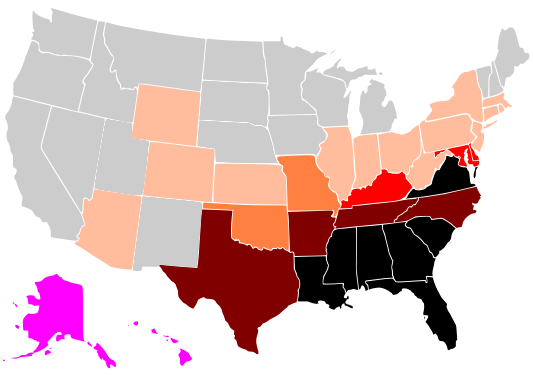
A map of the black percentage of the U.South. population by each country/territory in 1900.
Black = 35.00+%
Brown = xx.00-34.99%
Ruby = 10.00-nineteen.99%
Orange = 5.00-nine.99%
Light orange = 1.00-4.99%
Grey = 0.99% or less
Magenta = No data available -

A map of the black per centum of the U.Southward. population by each state/territory in 1990.
Black = 35.00+%
Dark-brown = 20.00–34.99%
Carmine = x.00–19.99%
Orange = 5.00–9.99%
Light orange = ane.00–4.99%
Gray = 0.99% or less
Pink = No information available -

A map showing the change in the total Blackness population (in percent) between 1900 and 1990 by U.S. country.
Lite imperial = Population reject
Very calorie-free green = Population growth of 0.01–9.99%
Low-cal green = Population growth of 10.00–99.99%
Green = Population growth of 100.00–999.99%
Night light-green = Population growth of 1,000.00–9,999.99%
Very dark green (or Black) = Population growth of 10,000.00% or more than
Magenta = No data available
New Nifty Migration [edit]
After the political and civil gains of the Civil Rights Motion, in the 1970s, migration began to increase again. It moved in a different direction, as Black people who were searching for economical opportunity traveled to new regions of the South.[72] [73]
See also [edit]
- 1912 Racial Conflict of Forsyth County, Georgia
- Exodusters
- Historical racial and ethnic demographics of the U.s.a.
- White flight
- Living for the City
- Hillbilly Highway
- Urban Appalachians
- African American settlements in Western Canada
- Back to Africa movement
Footnotes [edit]
- ^ "The Bully Migration (1910-1970)". May 20, 2021.
- ^ "The Keen Migration" (PDF). Smithsonian American Fine art Museum.
- ^ Wilkerson, Isabel. "The Long-Lasting Legacy of the Swell Migration". Smithsonian . Retrieved October 3, 2019.
- ^ a b Gregory, James. "Black Metropolis". America'southward Dandy Migrations Projects. Academy of Washington. Retrieved March 25, 2021. (with excepts from, Gregory, James. The Southern Diaspora: How the Keen Migrations of Blackness and White Southerners Transformed America, Chapter 4: Black City (University of Due north Carolina Press, 2005)
- ^ Wilkerson, Isabel (September 2016). "The Long-Lasting Legacy of the Great Migration". Smithsonian Magazine . Retrieved July 31, 2021.
- ^ Purvis, Thomas L. (1999). Balkin, Richard (ed.). Colonial America to 1763. New York: Facts on File. pp. 128–129. ISBN978-0816025275.
- ^ "Colonial and Pre-Federal Statistics" (PDF). United States Demography Bureau. p. 1168.
- ^ Gibson, Campbell; Jung, Kay (September 2002). HISTORICAL CENSUS STATISTICS ON POPULATION TOTALS By RACE, 1790 TO 1990, AND BY HISPANIC ORIGIN, 1970 TO 1990, FOR THE Us, REGIONS, DIVISIONS, AND STATES (PDF) (Study). Population Division Working Papers. Vol. 56. The states Census Bureau.
- ^ "Table 33. Louisiana – Race and Hispanic Origin: 1810 to 1990" (PDF). Archived from the original (PDF) on March 27, 2010.
- ^ "Race and Hispanic Origin for States" (PDF). Archived from the original (PDF) on Feb seven, 2014. Retrieved June 24, 2013.
- ^ "Table 39. Mississippi – Race and Hispanic Origin: 1800 to 1990" (PDF). Archived from the original (PDF) on March 27, 2010.
- ^ "The 2d Great Migration", The African American Migration Experience, New York Public Library, archived from the original on March 12, 2020, retrieved January 17, 2017
- ^ a b Taeuber, Karl E.; Taeuber, Alma F. (1966), "The Negro Population in the The states", in Davis, John P. (ed.), The American Negro Reference Volume, Englewood Cliffs, NJ: Prentice Hall, p. 122
- ^ "The Second Great Migration", The African American Migration Experience, New York Public Library, archived from the original on March 12, 2020, retrieved March 23, 2016
- ^ Lemann, Nicholas (1991). The Promised Land: The Bully Blackness Migration and How It Inverse America. New York: Alfred A. Knopf. p. vi. ISBN0-394-56004-3.
- ^ Frey, William H. (May 2004). "The New Great Migration: Black Americans' Return to the South, 1965–2000". The Brookings Institution. pp. ane–3. Archived from the original on June 17, 2013. Retrieved March xix, 2008.
- ^ Reniqua Allen (July 8, 2017). "Racism Is Everywhere, So Why Not Move S?". The New York Times . Retrieved July 9, 2017.
- ^ Glanton, Dahleen (July 13, 2020). "Returning Due south: A family revisits a double lynching that forced them to flee to Chicago 100 years agone". Chicago Tribune . Retrieved September 22, 2020.
- ^ "Lynchings: Past State and Race, 1882–1968". University of Missouri-Kansas Metropolis Schoolhouse of Law. Archived from the original on June 29, 2010. Retrieved July 26, 2010.
Statistics provided past the Archives at Tuskegee Institute.
- ^ a b Hine, Darlene; Hine, William; Harrold, Stanley (2012). African Americans: A Concise History (4th ed.). Boston: Pearson Educational activity, Inc. pp. 388–389. ISBN978-0-205-80627-0.
- ^ a b Kopf, Dan (January 28, 2016). "The Cracking Migration: The African American Exodus from The South". Priceonomics . Retrieved February 2, 2016.
- ^ a b Arnesen, Eric. (2003). Black protest and the dandy migration : a cursory history with documents. Boston: Bedford/St. Martin's. pp. 2–11. ISBN0-312-39129-3. OCLC 51099552.
- ^ a b Demography, Usa Bureau of the (July 23, 2010). "Migrations – The African-American Mosaic Exhibition – Exhibitions (Library of Congress)". www.loc.gov.
- ^ "Exodus to Kansas". August fifteen, 2016.
- ^ a b Arnesen, Eric. (2003). Black protest and the great migration : a brief history with documents. Boston: Bedford/St. Martin'southward. pp. 12–fifteen, 29–35. ISBN0-312-39129-3. OCLC 51099552.
- ^ Broussard, Albert S. (Spring 2011). "New Perspectives on Lynching, Race Riots, and Mob Violence". Journal of American Ethnic History. 30 (three): 71–75. doi:10.5406/jamerethnhist.30.3.0071 – via EBSCO.
- ^ a b Chicago Commission on Race Relations. The Negro in Chicago: A Written report in Race Relations and a Race Anarchism in 1919. Chicago: U of Chicago P, 1922.
- ^ a b "Chicago Race Riot of 1919." Encyclopedia Britannica. Encyclopædia Britannica, Inc., n.d. Web. May 20, 2017.<https://www.britannica.com/effect/Chicago-Race-Riot-of-1919>.
- ^ Drake, St. Claire; Cayton, Horace R. (1945). Black Urban center: A Study of Negro Life in a Northern Urban center. Us: Harcourt, Brace and Company. p. 65.
- ^ a b Gregory, James Northward. (2009) "The Second Great Migration: An Historical Overview," African American Urban History: The Dynamics of Race, Class, and Gender since World War II, eds. Joe West. Trotter Jr. and Kenneth Fifty. Kusmer. Chicago: University of Chicago Press
- ^ Gordon Marshall, "Sharecropping," Encyclopedia.com, 1998.
- ^ a b c d east Gregory, James N. (2005). The Southern Diaspora: How the Bully Migrations of Black and White Southerners Transformed America. Chapel Hill: Academy of Due north Carolina Printing. ISBN978-0-8078-5651-2.
- ^ Adams, Luther. (2010). Fashion up north in Louisville : African American migration in the urban South, 1930-1970. Chapel Colina: Academy of North Carolina Press. pp. 24–36. ISBN978-0-8078-9943-4. OCLC 682621088.
- ^ a b Lundberg, Terri (January 28, 2014). "Black History in Kansas City". Black Chick On Bout . Retrieved June 1, 2021.
- ^ Adams, Luther. (2010). Manner up northward in Louisville : African American migration in the urban South, 1930-1970. Chapel Hill: University of North Carolina Press. pp. 24–36. ISBN978-0-8078-9943-4. OCLC 682621088.
- ^ Stuart, Bryan A.; Taylor, Evan J. (2021). "Migration Networks and Location Decisions: Evidence from United states Mass Migration". American Economic Journal: Practical Economics. 13 (3): 134–175. doi:x.1257/app.20180294. hdl:10419/207533. ISSN 1945-7782. S2CID 141068688.
- ^ "Review: The Warmth of Other Suns: The Ballsy Story of America's Great Migration". Publishers Weekly. September 2010. Retrieved August sixteen, 2015.
- ^ www.sbctc.edu (adjusted). "Module one: Introduction and Definitions" (PDF). Saylor.org. Retrieved April 2, 2012.
- ^ Cotter, Holland (June 10, 2000). "Jacob Lawrence Is Dead at 82; Vivid Painter Who Chronicled Odyssey of Black Americans". The New York Times . Retrieved June xv, 2018.
- ^ David P. Szatmary, Rockin' in Fourth dimension, 8th ed. (Upper Saddle River, NJ: Pearson, 2014), p. viii
- ^ Abdul-Jabbar, Kareem; Obstfeld, Raymond (2007). On The Shoulders Of Giants : My Journeying Through the Harlem Renaissance. New York: Simon & Schuster. pp. 1–288. ISBN978-1-4165-3488-4. OCLC 76168045.
- ^ a b Gibson, Campbell and Kay Jung (September 2002). Historical Demography Statistics on Population Totals By Race, 1790 to 1990, and By Hispanic Origin, 1970 to 1990, For The United States, Regions, Divisions, and States. Archived Dec 24, 2014, at the Wayback Motorcar U.S. Bureau of the Demography – Population Partitioning.
- ^ a b James Gilbertlove, "African Americans and the American Labor Movement", Prologue, Summer 1997, Vol. 29.
- ^ Gibson, Campbell (June 1998). Population of the 100 Largest Cities and Other Urban Places in the The states: 1790 to 1990 Archived March fourteen, 2007, at the Wayback Machine. U.S. Bureau of the Demography – Population Partitioning.
- ^ a b Gibson, Campbell, and Kay Jung. "Historical Demography Statistics on Population Totals by Race, 1790 to 1990, and by Hispanic Origin, 1970 to 1990, for Large Cities and Other Urban Places in the United States." U.S. Census Bureau, February 2005.
- ^ Hutchinson, George (August 19, 2020). "Harlem Renaissance". Encyclopedia Britannica . Retrieved February 19, 2021.
{{cite spider web}}: CS1 maint: url-status (link) - ^ A Cursory Look at The Bronx, Bronx Historical Gild. Accessed September 23, 2007. Archived August 7, 2007, at the Wayback Car
- ^ Miller, Aurelia Toyer (1980). "The Social and Economic Condition of the Black Population in the U.S.: An Historical View, 1790–1978". The Review of Black Political Economy. x (3): 314–318. doi:10.1007/bf02689658. S2CID 153619673.
- ^ Ashenfelter, Orley (1970). "Changes in Labor Market Discrimination Over Time". The Journal of Human Resources. 5 (4): 403–430. doi:10.2307/144999. JSTOR 144999.
- ^ Thernstrom, Stephan (1973). The Other Bostonians: Poverty and Progress in the American Metropolis, 1880–1970. Cambridge, MA: Harvard University Press. p. 201. ISBN978-0674433946.
- ^ Historical Statistics of the United States: From Colonial Times to 1957 (Written report). Washington, D.C.: U.S. Census Bureau, U.S. Regime Printing Part. 1960. p. 72.
- ^ Thernstrom, Stephan; Thernstrom, Abigail (1997). America in Black and White: Ane Nation, Indivisible. New York: Simon & Schuster. p. 232. ISBN978-0684809335.
- ^ Gotham, Kevin Fox (2000). "Racialization and the Land: The Housing Act of 1934 and the Creation of the Federal Housing Assistants". Sociological Perspectives. 43 (2): 291–317. doi:10.2307/1389798. JSTOR 1389798. S2CID 144457751.
- ^ Lemak, Jennifer A. (2008). "Albany, New York and the Smashing Migration". Afro-Americans in New York Life and History. 32 (1): 47.
- ^ Joe West. Trotter, "Reflections on the Great Migration to Western Pennsylvania." Western Pennsylvania History (1995) 78#four: 153-158 online.
- ^ Joe W. Trotter, and Eric Ledell Smith, eds. African Americans in Pennsylvania: Shifting Historical Perspectives (Penn Land Press, 2010).
- ^ Trotter, "Reflections on the Corking Migration to Western Pennsylvania," p 154.
- ^ Black exodus : the dandy migration from the American South. Harrison, Alferdteen. Jackson: Academy Press of Mississippi. 1991. ISBN9781604738216. OCLC 775352334.
{{cite book}}: CS1 maint: others (link) - ^ "History". The Renaissance Collaborative. Archived from the original on Baronial 31, 2013. Retrieved August 19, 2013.
- ^ Poe, Tracy Due north. (1999). "The Origins of Soul Nutrient in Blackness Urban Identity: Chicago, 1915-1947," American Studies International. XXXVII No. 1 (Feb)
- ^ a b 'Ruralizing' the City: Theory, Civilisation, History, and Power in the Urban Environment Archived September 26, 2007, at the Wayback Auto
- ^ a b c d Reich, Steven A.: The Great Black Migration: A Historical Encyclopedia of the American Mosaic
- ^ a b Anderson, Talmadge and Stewart, James Benjamin: Introduction to African American Studies: Transdisciplinary Approaches and Implications
- ^ Elaine), Anderson, Ballad (Carol (May 31, 2016). White rage : the unspoken truth of our racial divide. New York, NY. ISBN9781632864123. OCLC 945729575.
- ^ Haygood, Wil (2013). The Butler: A Witness to History. 37 Ink. ISBN978-1476752990.
- ^ "August Wilson and The Migration to Pittsburgh". Hartford Stage . Retrieved June one, 2021.
- ^ a b Historical Census Statistics on Population Totals Past Race, 1790 to 1990, and By Hispanic Origin, 1970 to 1990, For The United states, Regions, Divisions, and States Archived December 24, 2014, at the Wayback Machine
- ^ a b "The Black Population: 2000" (PDF). Archived from the original (PDF) on October 25, 2012. Retrieved September 11, 2012.
- ^ a b "The Black Population: 2010" (PDF).
- ^ a b Population Division Working Newspaper – Historical Census Statistics On Population Totals Past Race, 1790 to 1990, and By Hispanic Origin, 1970 to 1990 – U.S. Census Bureau Archived August 12, 2012, at the Wayback Machine
- ^ a b Yax, Population Division, Laura K. "Population of the 100 Largest Cities and Other Urban Places In The U.s.a.: 1790 to 1990". www.census.gov.
- ^ Frey, William (2018). Diversity Explosion: How New Racial Demographics Are Remaking America. Brookings Institution Press. ISBN978-0815726494.
- ^ Toppo, Greg; Overberg, Paul (March 18, 2015). "After nearly 100 years, Great Migration begins reversal". USA Today . Retrieved Feb 19, 2021.
{{cite news}}: CS1 maint: url-status (link)
Farther reading [edit]
- Carl Zimmer, "Tales of African-American History Plant in DNA", New York Times, May 27, 2016
- Arnesen, Eric (2002). Black Protestation and the Keen Migration: A Brief History with Documents. Bedford: St. Martin's Press. ISBN0-312-39129-three.
- Baldwin, Davarian Fifty. Chicago's New Negroes: Modernity, the Great Migration, & Black Urban Life (Univ of North Carolina Press, 2007)
- Collins, William J. (November thirteen, 2020). "The Keen Migration of Black Americans from the US South: A Guide and Interpretation". Explorations in Economic History
- DeSantis, Alan D. "Selling the American dream myth to blackness southerners: The Chicago Defender and the Great Migration of 1915–1919." Western Journal of Communication (1998) 62#4 pp: 474–511. online
- Dove, Rita (1986). Thomas and Beulah. Carnegie Mellon University Press. ISBN0-88748-021-vii.
- Grossman, James R. (1991). Land of Promise: Chicago, Black Southerners, and the Dandy Migration . Chicago: University of Chicago Press. ISBN0-226-30995-ix.
- Holley, Donald. The Second Swell Emancipation: The Mechanical Cotton Picker, Black Migration, and How They Shaped the Modern South (University of Arkansas Printing, 2000)
- Lemann, Nicholas (1991). The Promised Land: The Great Black Migration and How It Changed America. Vintage Printing. ISBN0-679-73347-vii.
- Marks, Carole. Goodbye--We're Practiced and Gone: the great Blackness migration (Indiana Univ Press, 1989)
- Reich, Steven A. ed. The Swell Black Migration: A Historical Encyclopedia of the American Mosaic (2014), one-book abridged version of 2006 three volume gear up; Topical entries plus primary sources
- Rodgers, Lawrence Richard. Canaan Bound: The African-American Great Migration Novel (University of Illinois Printing, 1997)
- Sernett, Milton (1997). Jump for the Promised Land: African Americans' Religion and the Great Migration. Knuckles University Press. ISBN0-8223-1993-4.
- Scott, Emmett J. (1920). Negro Migration during the War.
- Sugrue, Thomas J. (2008). Sweet Land of Freedom: The Forgotten Struggle for Ceremonious Rights in the North. Random Business firm. ISBN978-0-8129-7038-8.
- Tolnay, Stewart E. "The African American" Cracking Migration" and Beyond." Almanac Review of Sociology (2003): 209-232. in JSTOR
- Tolnay, Stewart E. "The great migration and changes in the northern blackness family, 1940 to 1990." Social Forces (1997) 75#iv pp: 1213–1238.
- Trotter, Joe William, ed. The Bully Migration in historical perspective: New dimensions of race, class, and gender (Indiana Academy Press, 1991)
- Wilkerson, Isabel (2010). The Warmth of Other Suns: The Epic Story of America's Great Migration. Random House. ISBN978-0-679-60407-v. OCLC 741763572.
External links [edit]
- "The Groovy Migration". Digital Public Library of America . Retrieved January two, 2019.
- Schomburg Center'due south In Motility: The African-American Migration Experience Archived February 26, 2011, at the Wayback Machine
- Upwards from the Bottoms: The Search for the American Dream, (DVD on the GREAT MIGRATION)
- George King, "Goin' to Chicago and African American 'Great Migrations'", Southern Spaces, December 2, 2010.
- W Chester University, Goin' North: Stories from the First Cracking Migration to Philadelphia.

2.2.3 Practice African American Migration,
Source: https://en.wikipedia.org/wiki/Great_Migration_%28African_American%29
Posted by: barrenhersentooped.blogspot.com
0 Response to "2.2.3 Practice African American Migration"
Post a Comment